
Is your Jeep’s light show more spooky than safe? Learn how to fix jeep headlight flicker for good with this clear, step by step guide based on real owner experience.
That quick, random flash from your Jeep’s headlights is more than just annoying. It can be a safety worry and a sign of a growing electrical problem. If your Jeep Wrangler, Cherokee, or other model has headlights that blink on and off, you are not alone. This is a very common issue across many Jeep years and models. The good news? You can often fix jeep headlight flicker yourself without huge cost or deep mechanical skill. This guide will walk you through the most common causes, from the simple to the more involved, and show you the fixes that really work.
We will talk about bulbs, grounds, wiring, and more. By the end, you will have a clear plan to get your lights shining steady and bright again.
Why Do Jeep Headlights Flicker?
Before we look at how to fix the problem, it helps to know why it happens. Jeep headlight flicker is almost always an electrical issue. Your headlights need a steady, strong flow of power to work right. Anything that interrupts or changes that flow can make them flicker.
Think of it like water flowing through a hose. If you kink the hose, the water sputters. If the faucet is not opened all the way, the flow is weak. Your Jeep’s electrical system is similar. A loose connection is like a kink in the hose. A weak battery is like a half open faucet. We are looking for the kinks and the weak spots.
The most common reasons for flicker are bad bulbs, poor electrical grounding, and problems with the wiring or connectors. Newer Jeeps with LED lights can flicker for some special reasons, too.
“The bitterness of poor quality remains long after the sweetness of low price is forgotten.” – Benjamin Franklin
This old saying fits perfectly when you buy cheap auto parts. A low cost bulb might seem like a win, but its early failure and flickering will annoy you for months.
Step by Step: How to Diagnose and Fix the Flicker
Let us start with the easiest and most common fixes, then move to the more complex ones. Always be safe. Disconnect the battery before working on electrical parts.
1. Check and Replace Your Headlight Bulbs
This is the absolute first place to start, especially if your Jeep uses standard halogen bulbs. Over time, the filament inside a halogen bulb can wear out and become unstable. It might not be broken yet, but it can start to flicker as it fails.
How to do it:
- Turn on your headlights and give the housing a gentle tap with your finger. If the flicker changes or the light goes out, the bulb is likely the culprit.
- Turn off the vehicle and let the bulbs cool.
- Replace both headlight bulbs, even if only one is flickering. It is good practice. Use quality bulbs from trusted brands like Philips, Sylvania, or GE.
For Jeeps with factory LED lights: You cannot replace just the bulb. The flicker here points to a different problem, like a bad connection or a failing LED driver. Skip to the next steps.
2. Inspect and Clean Ground Connections
This is the #1 fix for probably 80% of Jeep headlight flicker issues. A “ground” is just a connection from the electrical circuit back to the battery’s negative terminal, usually through the Jeep’s metal frame. If this connection is rusty, loose, or painted over, the electricity cannot flow smoothly. This causes all sorts of weird issues, including flicker.
Common Ground Locations for Headlights:
- Near the battery in the engine bay.
- On the inner fender walls, left and right.
- Directly on the radiator support, behind the headlight housing.
How to fix a bad ground:
- Find the ground strap or wire. It is a black wire bolted to the body.
- Remove the bolt.
- Clean the metal ring on the wire and the spot on the Jeep’s body where it mounts with sandpaper or a wire brush until you see shiny, bare metal.
- Bolt it back down tightly. You can add a little dielectric grease to prevent future rust.
This simple, free fix has solved countless flicker problems for Jeep owners.
3. Look at Wiring and Connectors
After grounds, the next thing to check is the physical wiring. The constant engine vibration and weather in a Jeep can wear out wires and loosen plugs.
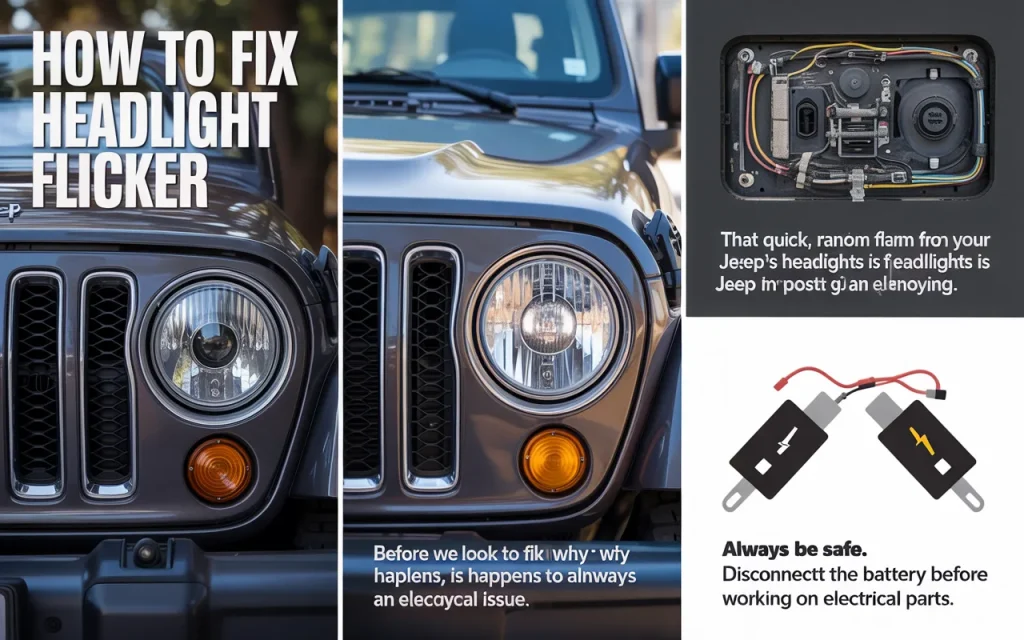
- Check the Headlight Harness Connector: Unplug the connector at the back of each headlight. Look for any pins that are bent, green with corrosion, or look burned. A spray of electrical contact cleaner can work wonders here.
- Look for Chafed Wires: Follow the wiring from the headlight back a short way. Look for any spots where the plastic coating is rubbed off, exposing bare wire. This can cause a short circuit and flicker.
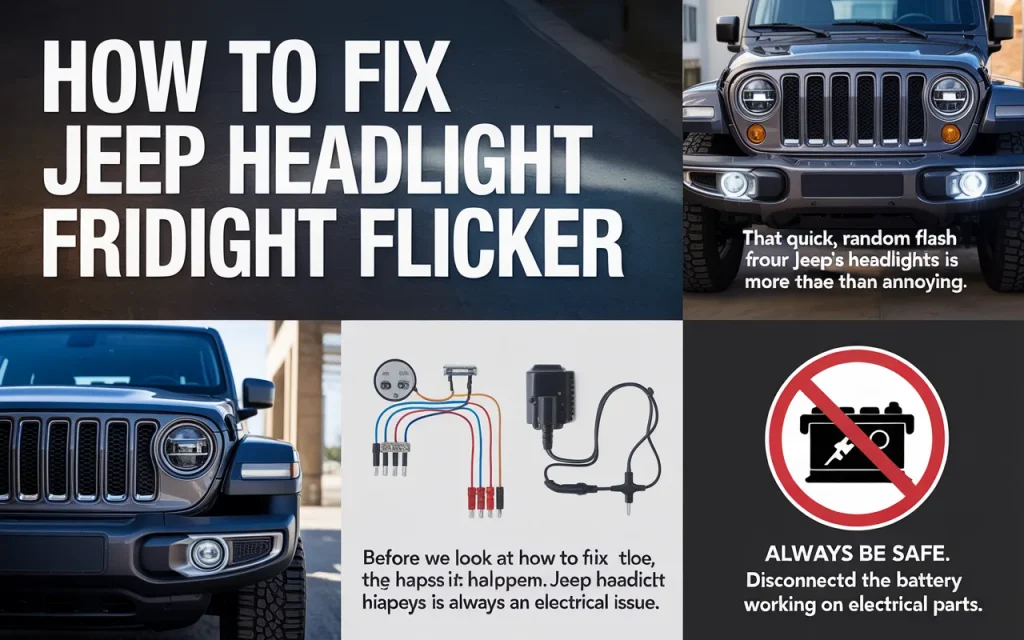
- Consider a Headlight Wiring Harness Upgrade: Many Jeeps, especially older Wranglers (TJ, JK), have thin factory wiring. The headlights get just enough power. Upgrading to a heavy duty harness with relays gives your bulbs full, clean power directly from the battery. This often cures flicker and makes your headlights noticeably brighter.
| Fix | Cost | Difficulty | Likely Cause It Solves |
|---|---|---|---|
| Replace Bulbs | Low | Easy | Worn out halogen bulbs |
| Clean Grounds | Free | Easy | Poor electrical connection |
| Add Harness Kit | Medium | Medium | Weak factory wiring |
4. Test the Battery and Alternator
Sometimes, the flicker is a symptom of a bigger system issue. A weak battery or an alternator that is not charging properly can cause the whole electrical system to behave badly, with lights dimming or flickering when you rev the engine.
- Battery Test: Use a multimeter. With the car off, a good battery should read about 12.6 volts. With the engine running, it should read 13.7 to 14.7 volts. If it is lower, your alternator might be failing.
- Alternator Test: With the engine running and headlights on, check the voltage at the battery again. If it is not in the 13.7-14.7V range, have your alternator checked at a parts store.
Special Case: Fixing LED Headlight Flicker
If your Jeep has LED lights, either factory or aftermarket, the rules change a bit. LEDs are very sensitive to changes in current. They do not flicker because of a worn out part like a halogen bulb. They flicker because of electrical noise or compatibility issues.
- CanBus Decoders/Resistors: Many modern Jeeps use a computer system (CanBus) to check if bulbs are working. LEDs use so little power that the computer thinks the bulb is out and may cut power, causing flicker. Adding a small CanBus decoder or resistor fools the computer and provides a steady current.
- Anti Flicker Harness: This is a ready made cable with the needed resistors built in. It plugs between your Jeep’s factory wiring and the LED headlight plug.
- Bad LED Driver: Inside every LED assembly is a small circuit board called a driver. It can fail. If one LED headlight flickers and the other is fine, a bad driver in that unit is likely.
“Speculation is perfectly all right, but if you stay there you’ve only founded a superstition. If you test it, you’ve started a science.” – John M. Allegro
Do not just guess which fix you need. Test things. Check the grounds first because it is free. Then move to the next simplest test. This methodical approach is how you solve electrical problems for good.
When to See a Professional Mechanic
Most flicker issues can be handled in your driveway. But sometimes, you need expert help.
- If you have done all the common fixes and the problem remains.
- If you see damaged wiring that is deep in the harness or looks complex.
- If the flicker is paired with other major electrical problems (dashboard lights going crazy, car stalling).
- If you are not comfortable working with electrical systems. It is always okay to call a pro.
A good auto electrician can run advanced diagnostics to find the exact point of voltage drop or interruption.
How to Stop Headlight Flicker From Coming Back
Prevention is the best medicine. After you fix jeep headlight flicker, keep it away.
- Use dielectric grease on every electrical connector you touch. It keeps out water and stops corrosion.
- Check your main battery connections once a year. Clean them if they look dirty.
- If you install aftermarket lights, always use a proper harness kit. Do not just splice wires into the factory ones.
- Buy good quality parts. This goes for bulbs, wiring kits, and especially LED upgrades.
| Prevention Task | How Often | Why It Helps |
|---|---|---|
| Check Battery Terminals | Once a Year | Prevents poor starting and voltage issues |
| Use Dielectric Grease | At Every Repair | Stops corrosion in connectors |
| Choose Quality Parts | For Every Purchase | Reliable parts last longer and work right |
Frequently Asked Questions (FAQ)
Q: Is headlight flicker dangerous?
A: It can be. The main danger is the light suddenly going out while you are driving at night. It also points to an electrical fault that could get worse. It is best to fix it soon.
Q: Can a bad fuse cause headlight flicker?
A: Usually not. A bad fuse normally causes a complete failure, not a flicker. But it is very easy to check, so look at your headlight fuse in the Power Distribution Center (PDC) under the hood to be sure it is seated tightly.
Q: Why do my Jeep’s headlights flicker only when the engine is idle?
A: This is a classic sign of a voltage issue. At idle, the alternator spins slower and makes less power. If your battery is weak or your alternator is starting to fail, the voltage can dip low enough at idle to cause lights to flicker, especially if you have power hungry accessories on.
Q: Will an aftermarket headlight harness fix flicker on my Jeep Wrangler JK?
A: In many cases, yes. The factory wiring on many Jeeps is fairly thin. A quality relay harness delivers full battery voltage directly to the headlights on thicker wires, which often cures flicker and improves brightness.
Q: My LED DRLs (Daytime Running Lights) flicker, but my main beams are fine. What gives?
A: This is almost always a need for a CanBus decoder or anti flicker module designed for DRLs. The computer system is checking that circuit and needs the load balanced.
Conclusion
Learning how to fix jeep headlight flicker is a right of passage for many owners. It feels great to solve a common, annoying problem with your own hands. Remember the path: start with the simple things. Check your bulbs. Clean your ground connections until they shine. Look at the plugs and wires. For LEDs, think about decoders and harnesses. Work through these steps, and you will most likely find your answer.
“The only real mistake is the one from which we learn nothing.” – Henry Ford
Do not get frustrated if the first thing you try does not work. Each test teaches you more about your Jeep’s electrical system. That knowledge is valuable for the next repair.
Doing this job right means safer night driving and the satisfaction of a job done well. Grab your tools, stay safe, and get those lights shining steady. Your Jeep and your driving will be better for it.