
How To Fix Jeep AC Blowing Warm Air
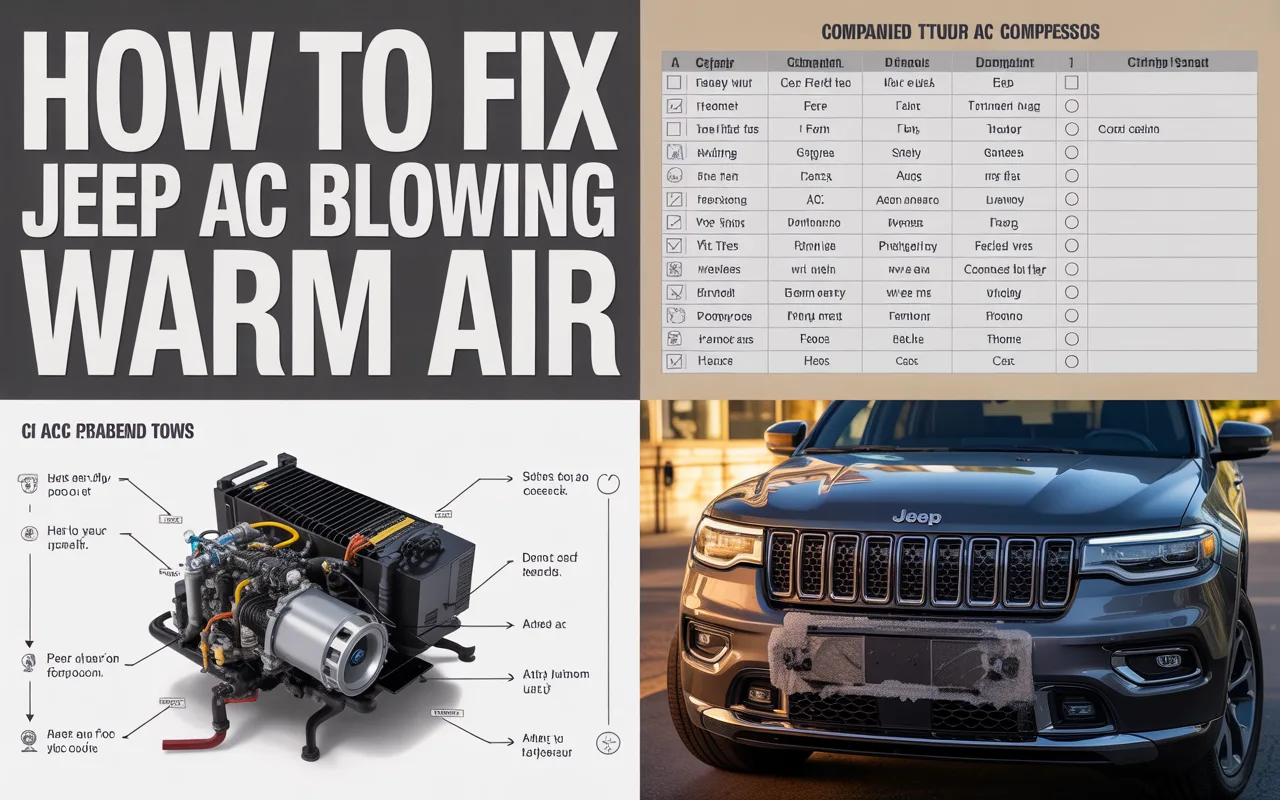
Is your Jeep AC blowing warm air? Learn exactly how to fix Jeep AC blowing warm air with this complete DIY guide covering common causes and simple repairs.
Getting into your Jeep on a scorching summer day should mean immediate relief. But when you turn the dial and only feel hot air pushing through the vents, it ruins the whole experience. I have been there myself, sitting in traffic, sweating, and wondering what went wrong. The good news is that figuring out how to fix Jeep AC blowing warm air is often simpler than you might think. Most causes fall into a few common categories, and many of them you can check on your own without special tools.
Let us walk through the reasons your Jeep might be blowing hot air and the steps you can take to get that cold air flowing again. Whether you drive a Wrangler, Grand Cherokee, or Compass, these tips apply across the board .
Quick Diagnosis: Where to Start First
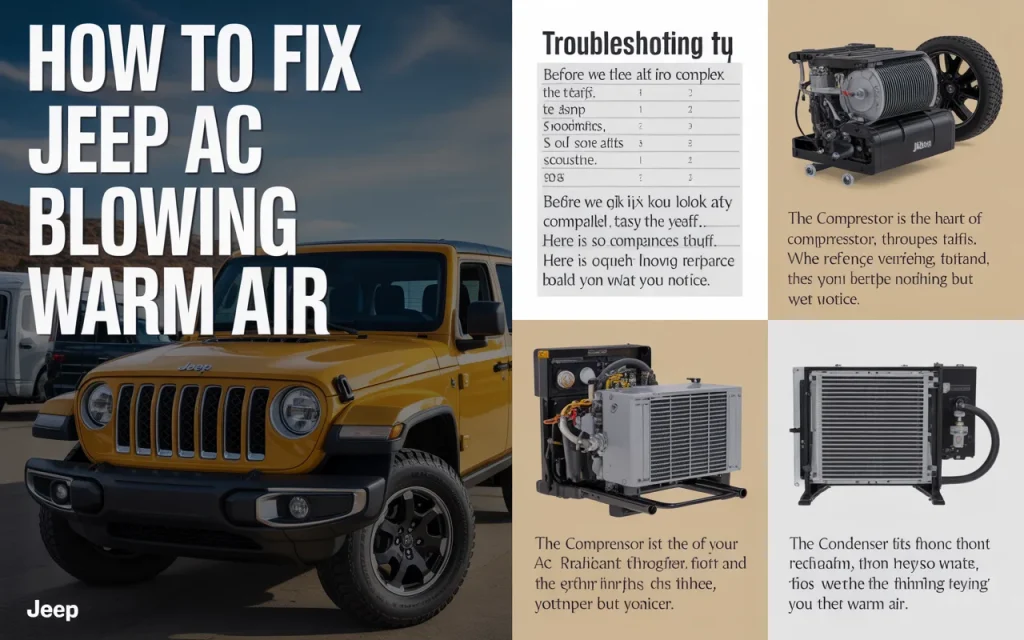
Before we get into complex repairs, let us look at the easy stuff. Sometimes the fix is so simple we overlook it. Here is a quick reference table to help you narrow down the problem based on what you notice.
| Symptom You Notice | Most Likely Cause | Quick Check |
|---|---|---|
| Air blows but not cold | Low refrigerant | Look for oily residue on hoses |
| No air at all | Blower motor or fuse | Check fuse box under hood |
| Clicking when AC turned on | Compressor issue | Watch if clutch engages |
| Works sometimes, then warm | Electrical glitch | Try system reset |
| Weak airflow | Clogged filter | Inspect cabin air filter |
I always tell friends to start with the cabin air filter. It sits behind the glove box and collects dust, leaves, and everything else. If it looks like something you would find under a porch, replace it. This alone can restore airflow and make the system feel like it is working better .
Common Reasons Your Jeep AC Blows Warm Air
Low Refrigerant: The Usual Suspect
The most frequent reason for warm air is simply not enough refrigerant in the system. Refrigerant is the special fluid that absorbs heat from inside your Jeep and releases it outside. When levels drop, the system cannot remove heat effectively .
If your AC worked fine last month and now blows warm, low refrigerant is likely the culprit. The tricky part is that refrigerant does not just disappear. If it is low, you have a leak somewhere. Sometimes you can spot these leaks by looking for oily spots on the hoses or fittings. You might even hear a faint hissing sound with the engine off .
Quote from a Jeep Owner: “I found out that the suction line connecting the evaporator to the condenser was leaking pressure. There is no temporary fix for a bad line.” — JustanAverageGuy, Jeep Wrangler Forum
This quote hits on an important point. Trying to just top off the refrigerant without fixing the leak is like putting gas in a car with a hole in the tank. It might work for a little while, but you will be right back where you started.
AC Compressor Failure
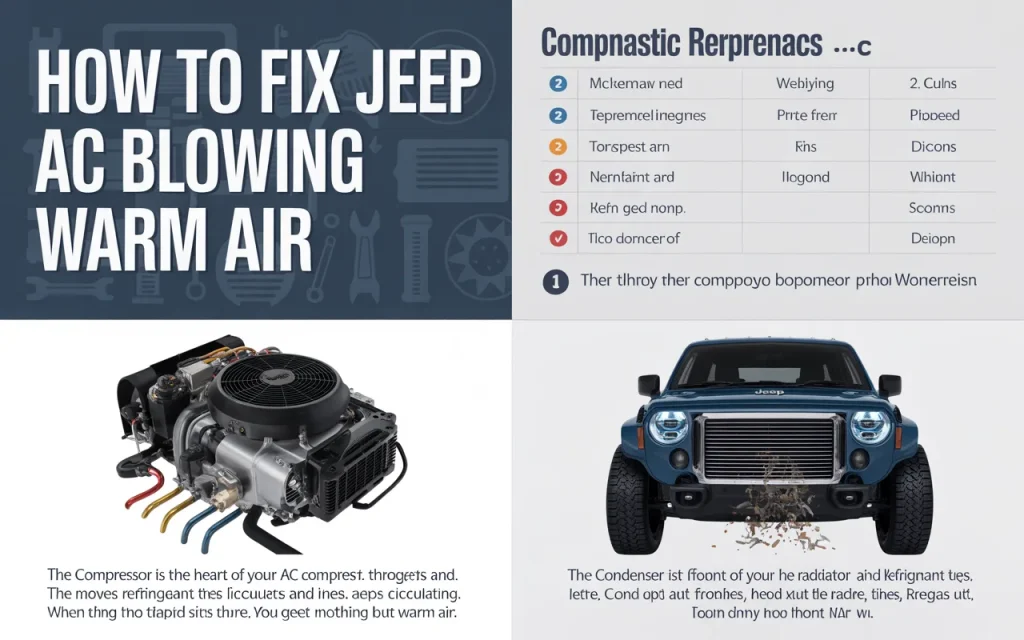
The compressor is the heart of your AC system. It moves refrigerant through the lines and keeps everything circulating. When the compressor fails, the refrigerant just sits there, and you get nothing but warm air .
You might notice strange noises when you turn on the AC. Clicking, grinding, or rattling sounds can mean the compressor clutch is going bad. Sometimes the clutch just stops engaging altogether. Pop the hood and watch the compressor while someone turns the AC on and off. If the center part does not spin, you likely found your problem.
Electrical Problems and Sensor Issues
Modern Jeeps rely on sensors and control modules to manage the AC system. When these electronics act up, the system can behave in strange ways. One day it works, the next day it does not. Or maybe it blows cold for a few minutes then switches back to warm .
Some Jeep owners have reported issues with the automatic temperature control module flashing before the AC stops working completely. This often points to an electronic control problem rather than a mechanical failure .
In some cases, a simple system reset can fix the issue. Turn the Jeep completely off, wait a few minutes, and restart. This clears the control module’s memory and can resolve minor glitches .
Clogged Condenser
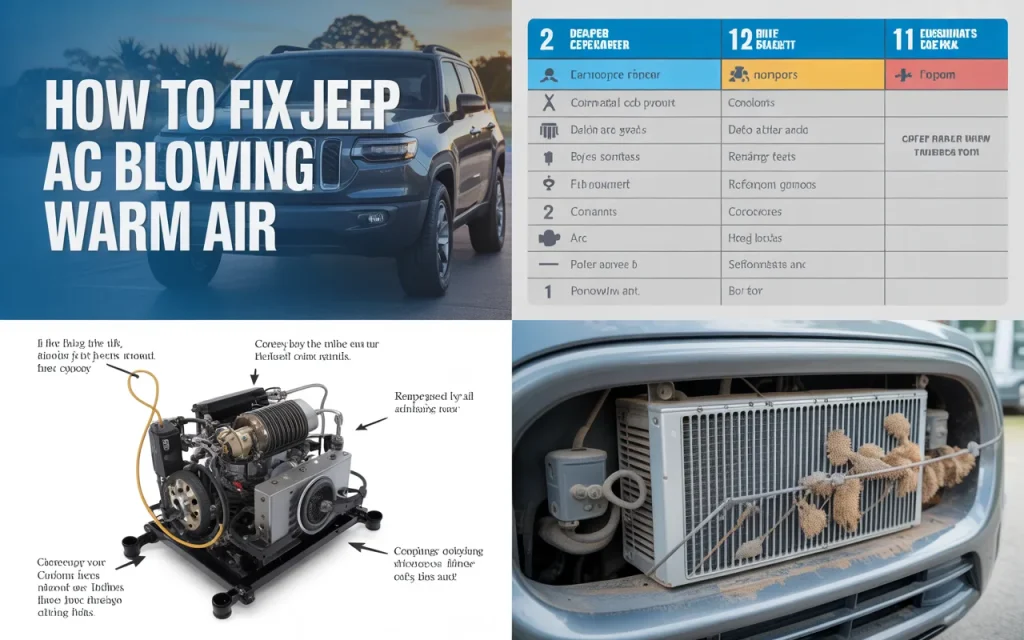
The condenser sits in front of your radiator and looks like a small radiator itself. Its job is to cool down the hot refrigerant so it can absorb more heat later. If the condenser gets clogged with bugs, leaves, or debris, air cannot flow through it properly. Heat gets trapped, and your AC struggles .
This happens a lot if you park under trees or do any off-roading through tall grass. A visual inspection can often spot the problem. Sometimes a gentle spray from a hose can clear out the debris and restore function.
Blend Door Actuator Failure
Here is one that confuses a lot of owners. The blend door is a little flap inside your dashboard that controls whether air flows through the heater core or the AC evaporator. When the actuator that moves this door fails, you might get hot air even though the AC is working perfectly .
You can sometimes hear this problem. If you change the temperature setting and hear clicking behind the dash but the air temperature does not change, the blend door actuator might be broken. The AC system is fine, but the air is going the wrong way.
Step-by-Step: How to Fix Jeep AC Blowing Warm Air
Now let us get into the actual repair steps. I will break these down from easiest to most involved. You can decide how far you want to go based on your comfort level.
Step 1: Check the Basics First
Open the hood and look at the AC lines. Find the low-pressure service port, which usually has a plastic cap marked with an L. If you see ice forming on this line, the system might be low on refrigerant. Oily residue around fittings also points to leaks .
Check all your fuses related to the HVAC system. The fuse box diagram inside the cover will show you which ones control the AC. A blown fuse is an easy fix.
Try the system reset I mentioned earlier. Turn off the Jeep, remove the key, and wait five full minutes. Start it up and test the AC again. You would be surprised how often this works.
Step 2: Test the Refrigerant Pressure
You can buy a basic refrigerant gauge at any auto parts store. It attaches to the low-pressure port and shows you if the system has enough refrigerant. Most kits come with a chart showing the proper pressure range for outside temperatures .
If the pressure reads low, you likely have a leak. You can try adding refrigerant from a can, but remember what we said about leaks. It might get you through the weekend, but you will need to find and fix the leak eventually.
Expert Advice from a Professional Mechanic: “Muchas veces, lo más sencillo es lo más complicado. The importance of a good diagnostic cannot be overstated. Sometimes the simplest fix is right in front of you.” — Ángel Gaitán, Professional Mechanic
This wisdom from Ángel reminds us that throwing parts at the problem without proper diagnosis wastes time and money. Check everything carefully before replacing expensive components.
Step 3: Inspect the Compressor Operation
With the engine running and the AC turned to max, watch the compressor clutch. It should click and start spinning within a few seconds. If it does not engage, you have a few possibilities:
- Low refrigerant (the safety switch prevents engagement)
- Bad clutch coil
- Failed compressor
- Electrical issue in the control circuit
You can test the clutch by applying 12 volts directly to it. If it clicks and spins, the compressor is probably fine and the problem lies elsewhere .
Step 4: Check for Error Codes
Newer Jeeps store diagnostic trouble codes for the HVAC system. You might need a scan tool to read these, but some parts stores will do it for free. Codes like P0532 indicate low pressure in the system, while B1411 points to communication problems with the climate control module .
One Jeep Commander owner shared their experience: “After getting my Commander checked at the shop, it turned out to be exactly what the last reply suggested, a faulty climate control module. The mechanic confirmed both error codes were directly related to the module failure.” — detlef_schwarz12, Carly Community
This shows how important proper diagnosis can be. They fixed the problem by replacing the correct part rather than guessing.
Step 5: Inspect for Visible Leaks
If you suspect a leak, a mixture of soap and water sprayed on connections can reveal bubbles where refrigerant escapes. This old trick works surprisingly well. Pay special attention to hose connections and the compressor shaft seal .
If you find a leak in a hose, replacement is the only real fix. Temporary sealants exist, but most mechanics advise against them because they can clog other parts of the system .
Step 6: Address Electrical Connections
Loose or corroded electrical connections can cause intermittent AC problems. Check the connectors at the compressor, pressure switches, and control module. Sometimes simply unplugging and reconnecting them cleans the contacts enough to restore function .
In some cases, damaged wiring harnesses cause shorts that affect the entire system. A Jeep Grand Cherokee owner found that worn insulation on a wiring harness caused a short circuit that disabled the climate control completely .
When to Call a Professional
Some AC repairs require special tools and knowledge. Here is a table to help you decide if this is a DIY job or one for the shop.
| Repair Type | DIY Difficulty | Tools Needed | When to Call Pro |
|---|---|---|---|
| Add refrigerant | Easy | Refrigerant can with gauge | If system needs frequent refills |
| Replace cabin filter | Very Easy | None | Never, this is always DIY |
| Fix electrical connection | Moderate | Multimeter, basic tools | If you cannot find the problem |
| Replace compressor | Hard | AC manifold gauges, vacuum pump | If you lack experience |
| Find hidden leak | Hard | Electronic leak detector | If soap test shows nothing |
| Control module replacement | Moderate | Scan tool for programming | If module needs dealer programming |
Some Jeep models have specific quirks. For example, certain Wranglers and Compass models have issues with the Totally Integrated Power Module that controls the AC system. Diagnosing these problems requires experience with these specific vehicles .
Experienced Mechanic’s Advice: “A vacuum pump is required to evacuate the system before charging it. And a set of AC gauges. Not something to do without experienced help the first time around.” — JKP, Jeep Forum Member
This is honest advice. AC systems operate under high pressure, and doing it wrong can cause injury or damage expensive components.
Specific Issues by Jeep Model
Different Jeep models have their own common problems. Knowing what tends to fail on your specific vehicle can save diagnostic time.
Jeep Wrangler (TJ, JK, JL)
Older Wranglers like the TJ often develop leaks in the suction line where it rubs against the fender. This chafing wears through the line over time and causes refrigerant loss . Newer Wranglers sometimes have issues with the automatic temperature control module. Owners report the module flashing before the system stops cooling .
Jeep Grand Cherokee (WJ, WK, WK2)
The WJ generation (1999-2004) has a reputation for small leaks that accumulate over time. Owners often find themselves adding refrigerant every year until they fix all the leaks properly .
Jeep Commander
Commanders can experience complete HVAC system failure due to faulty climate control modules. Error codes P0532 and B1411 often point to module problems rather than mechanical issues .
Jeep Compass and Patriot
These models sometimes have electrical problems traced to the TIPM. This module controls power to many systems, including the AC. When it fails, the blower motor might not work even though everything else seems fine .
Preventing Future AC Problems
Once you fix the issue, you want to keep it working. Here are simple habits that extend the life of your AC system.
Run the AC at least once a week, even in winter. This keeps the seals lubricated and prevents them from drying out and leaking. The compressor needs to circulate oil regularly to stay healthy.
Keep the area in front of the condenser clean. If you off-road, check for debris packed into the condenser fins. A gentle spray from a garden hose can remove built-up dirt.
Watch for early warning signs. If the AC takes longer to cool than it used to, or if it blows cold but not as cold as before, investigate early. Small problems become big problems when ignored.
Have the system serviced every two to three years. A professional evacuation and recharge removes moisture and old oil, replacing it with fresh refrigerant and lubricant. This preventive maintenance catches small leaks before they become big ones.
Frequently Asked Questions
How do I know if my Jeep AC compressor is bad?
Listen for clicking or grinding noises when the AC is on. Watch the compressor clutch to see if it spins. If the clutch does not engage, the compressor might be failing, or you could have low refrigerant or an electrical problem .
Can I just add refrigerant to my Jeep AC?
You can, but it is a temporary fix if you have a leak. Adding refrigerant might get you through a hot day, but the system will lose it again. Find and fix the leak for a permanent solution .
Why does my Jeep AC work sometimes but not other times?
Intermittent problems often point to electrical issues. Loose connections, failing relays, or control module glitches can cause the system to work one minute and fail the next. Try a system reset by disconnecting the battery for a few minutes .
How much does it cost to fix Jeep AC?
Costs vary widely based on the problem. A simple refrigerant recharge might cost 50 to 100 dollars. Compressor replacement can run 500 to 1000 dollars or more. Diagnostic fees at shops typically range from 100 to 150 dollars .
Can a clogged cabin air filter cause warm air?
Not exactly. A clogged filter restricts airflow, so even if the AC is cooling the air, very little of it reaches you. This makes it feel like the AC is not working. Check and replace the cabin filter regularly .
Is it safe to drive my Jeep with the AC blowing warm?
Yes, it is safe to drive. The AC system is separate from engine operation. You might be uncomfortable, but you will not damage the vehicle by driving with non-working AC.
How do I reset my Jeep AC system?
Try disconnecting the negative battery cable for 10 to 15 minutes. This resets the various control modules. Some Jeeps also have specific reset procedures involving the climate control buttons, so check your owner’s manual .
What does it mean when my AC clutch clicks on and off rapidly?
Rapid cycling usually means the system is low on refrigerant. The pressure switch turns the compressor on, but pressure drops quickly, so it turns off again. This short cycling can damage the compressor over time .
Conclusion
Dealing with a Jeep AC that blows warm air tests your patience, especially in summer heat. But now you have a clear path forward. Start with the simple checks, work through the possibilities, and fix the root cause rather than just the symptoms.
Remember that refrigerant leaks do not heal themselves. If your system is low, find the leak. If electrical parts act up, check connections and control modules. And if the job feels too big, there is no shame in calling a professional who works on Jeeps every day.
The cool breeze through your vents is worth the effort. Your Jeep is built for adventure, and every adventure is better when you are comfortable along the way. Stay cool out there.
Related posts
 Best Car Mats for All-Weather Use 2026: Top Picks for Every Driver
Keeping your car clean is tough, especially when rain, mud, and snow are involved. That’s where the best car mats for all-weather use make a difference.…
 Best Custom-Fit Floor Mats for Nissan Titan: Top Picks 2026
These custom-fit mats provide reliable coverage and help protect your Nissan Titan’s interior from dirt and spills. It’s Monday morning, you’re rushing out the door with…
 Best Car Cleaning Wipes for Interior: A Buyer’s Guide
Discover the best car cleaning wipes for your interior. Compare options for dashboards, leather, and tough stains to keep your car spotless and well-maintained. Keeping your…