
Jeep Turbo Problems Explained
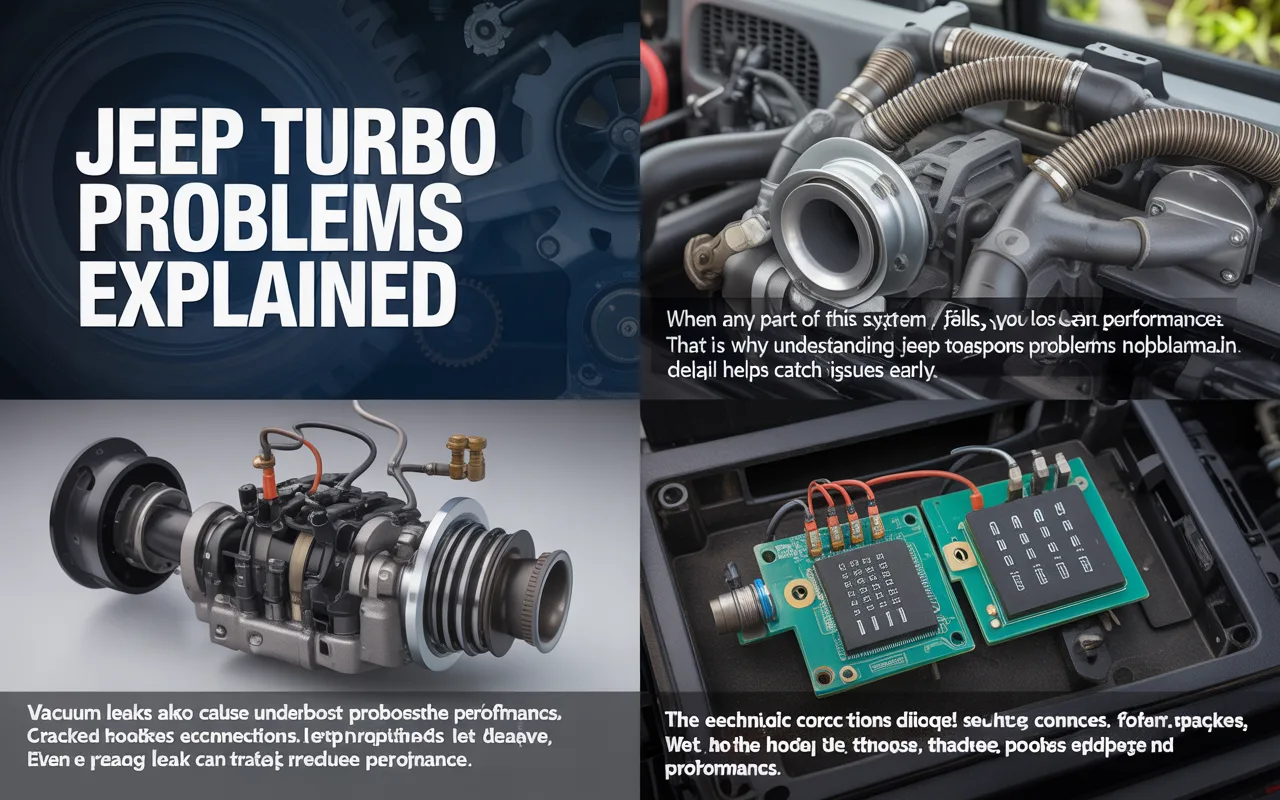
Common Jeep turbo problems explained simply. Learn about P0299 codes, turbo actuator failure, 2.0L engine issues, symptoms, fixes, and maintenance tips from real owner experiences.
If you own a Jeep with a turbocharged engine or are thinking about buying one, you probably have questions about reliability. Turbochargers add power and efficiency, but they also bring their own set of challenges. Some Jeep owners love their turbo engines, while others deal with frustrating breakdowns.
Let’s talk about Jeep turbo problems explained in plain language. I have researched owner forums, talked with mechanics, and gathered real experiences to help you understand what goes wrong, why it happens, and how to fix it. Whether you drive a Wrangler with the 2.0L Hurricane engine or a Grand Cherokee with a diesel, this guide covers the issues you need to know about.
What Does the Turbocharger Actually Do in Your Jeep?
Before jumping into problems, it helps to understand what the turbo does. The turbocharger forces extra air into your engine’s cylinders. More air means more fuel can burn, which creates more power. Your Jeep gets better acceleration and can maintain highway speeds without working as hard.
The system includes several parts that work together. The turbine spins using exhaust gases. That spinning motion drives a compressor that pushes air into the engine. A wastegate controls how much boost pressure builds up. The actuator opens and closes the wastegate based on signals from the computer. Intercoolers cool the compressed air before it enters the engine.
When any part of this system fails, you lose power and performance. That is why understanding Jeep turbo problems explained in detail helps you catch issues early.
The Most Common Jeep Turbo Failure: P0299 Code
The P0299 trouble code appears frequently in Jeep forums and repair shops. This code means “turbo underboost” – the engine computer detects that boost pressure is lower than it should be . Your Jeep expects a certain amount of air pressure from the turbo, and when that pressure does not show up, the computer gets concerned.
Why Does the P0299 Code Appear?
Several things trigger this code. The most common cause is a failing turbo actuator. This small electronic or vacuum-powered part controls the wastegate. When it sticks or fails, the turbo cannot build proper pressure .
Vacuum leaks also cause underboost problems. Cracked hoses or loose connections let pressure escape before it reaches the engine. Even a small leak can trigger the code and reduce performance .
Another cause involves the variable geometry mechanism in some turbos. Carbon buildup from exhaust gases can make the vanes stick. When they cannot move freely, boost pressure suffers .
| Common Cause | What Happens | Fix Approach |
|---|---|---|
| Faulty turbo actuator | Wastegate doesn’t open/close correctly | Replace or rebuild actuator |
| Vacuum or boost leaks | Pressure escapes through cracks | Replace damaged hoses, tighten connections |
| Carbon buildup | Vanes stick and cannot adjust | Clean turbo mechanism manually |
| Clogged DPF or catalytic converter | Exhaust flow restricted | Clean or replace blocked components |
Turbo Actuator Failure: The Usual Suspect
When mechanics look at Jeep turbo problems explained in detail, the actuator comes up more than any other part. Between 2005 and 2015, many Jeeps used Hella turbo actuators with Garrett turbochargers . These actuators have known weak points.
The electronic circuit boards inside develop loose connections over time. Heat and vibration cause solder joints to crack. When that happens, the actuator stops responding correctly. The wastegate might stay closed, causing overboost, or stay open, causing underboost .
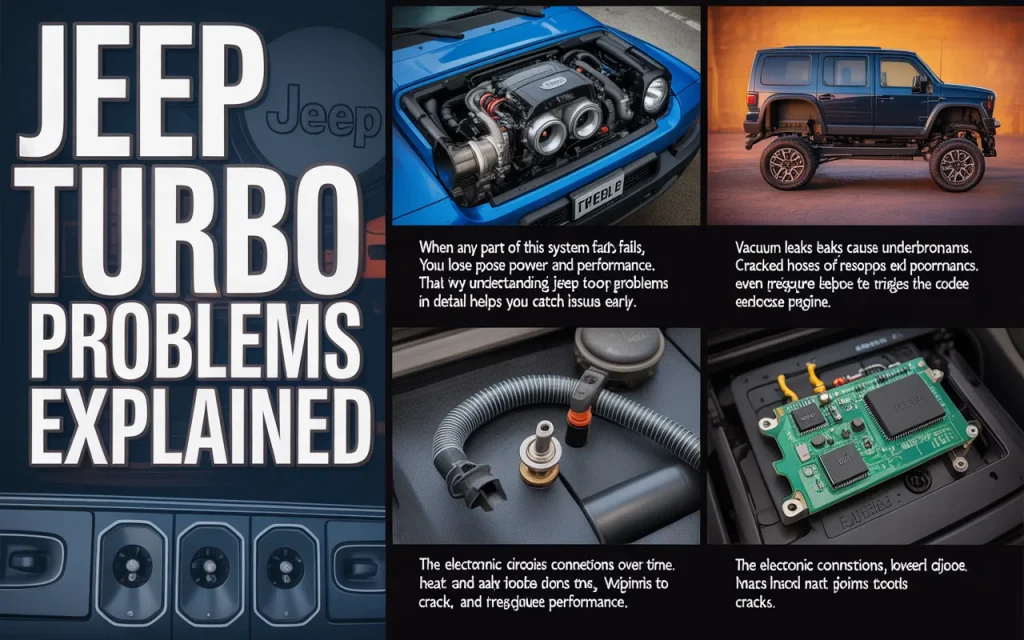
Mechanical wear also happens. The gears inside the actuator can wear down after years of use. This leads to sloppy movement and poor boost control. Some owners report the actuator arm seizing completely, which leaves the wastegate stuck in one position .
“The turbo actuator on my 2015 Grand Cherokee failed at 80,000 miles. The check engine light came on, and I had almost no power going up hills. A rebuilt actuator fixed it right away.” – Mark T., Jeep Forum Member
Jeep 2.0L Turbo Engine Problems
The 2.0-liter Hurricane engine arrived in 2018 and brought modern turbo technology to Jeeps. It makes 270 horsepower and 295 pound-feet of torque, which beats some V6 options . But owners have found some recurring issues.
Oil Consumption Worries
Excessive oil use tops the list of complaints. Some 2.0L owners report adding oil between changes, sometimes a quart every 1,000 miles . This matters because turbochargers need clean oil to survive. Low oil levels or delayed changes can damage turbo bearings.
The engine has specific oil requirements. Using the wrong oil or stretching change intervals makes consumption worse. Some owners have experienced engine damage from low-speed pre-ignition, which connects to oil burning inside cylinders .
Cooling System Troubles
The 2.0L turbo runs hot, and the cooling system must work perfectly to prevent problems. Owners report coolant leaks, especially from battery pack connections in models with the eTorque system . Low coolant leads to overheating, which damages turbo seals and engine components.
Thermostat failures also happen. When the thermostat sticks closed, temperatures climb quickly. A Jeep with an overheating turbo risks oil coking – where oil burns inside the turbo and blocks passages .
Turbo Lag Complaints
Some drivers notice hesitation when accelerating. The turbo takes a moment to spool up, which feels different from the instant response of a V6 . This is normal for turbo engines, but some owners find it annoying, especially when off-roading where precise throttle control matters.
Symptoms Your Jeep Turbo Needs Attention
How do you know if your turbo is failing? Watch for these signs:
Loss of power is the most obvious clue. Your Jeep struggles to accelerate, especially going uphill or passing on the highway. The engine might feel flat no matter how hard you press the gas.
Check engine lights often accompany turbo problems. Codes like P0299 (underboost) or P0234 (overboost) point directly to turbo system issues .
Strange noises deserve attention. A whining or screeching sound from the engine bay can mean worn turbo bearings. Hissing noises suggest boost leaks .
Excessive smoke tells a story. Blue smoke means oil burning – possibly leaking turbo seals. Black smoke indicates too much fuel and not enough air. White smoke on startup might be normal condensation, but persistent white smoke suggests coolant burning .
I noticed my 2020 Wrangler felt sluggish for weeks before the check engine light came on. The dealer found the actuator was sticking. If I had brought it in sooner, maybe I could have avoided the turbo damage.” – Sarah K., Wrangler Owner
Diagnosing Turbo Problems Step by Step
You can check many things yourself before visiting a mechanic. Start with simple visual inspections.
Look at all the air intake hoses. Cracks, loose clamps, or oily residue around connections indicate leaks. Pay special attention to the hose between the turbo and intercooler – this area sees high pressure and often fails first .
Check the wastegate actuator arm if you can reach it. On many Jeeps, this arm connects the actuator to the wastegate. Try moving it by hand when the engine is cold. It should move smoothly with some resistance. If it feels stuck or grindy, the mechanism has problems .
Listen for unusual turbo sounds. Start the engine and let it idle. Rev it gently and listen for whining that changes with engine speed. A healthy turbo makes a quiet spooling sound. Loud noises mean trouble .
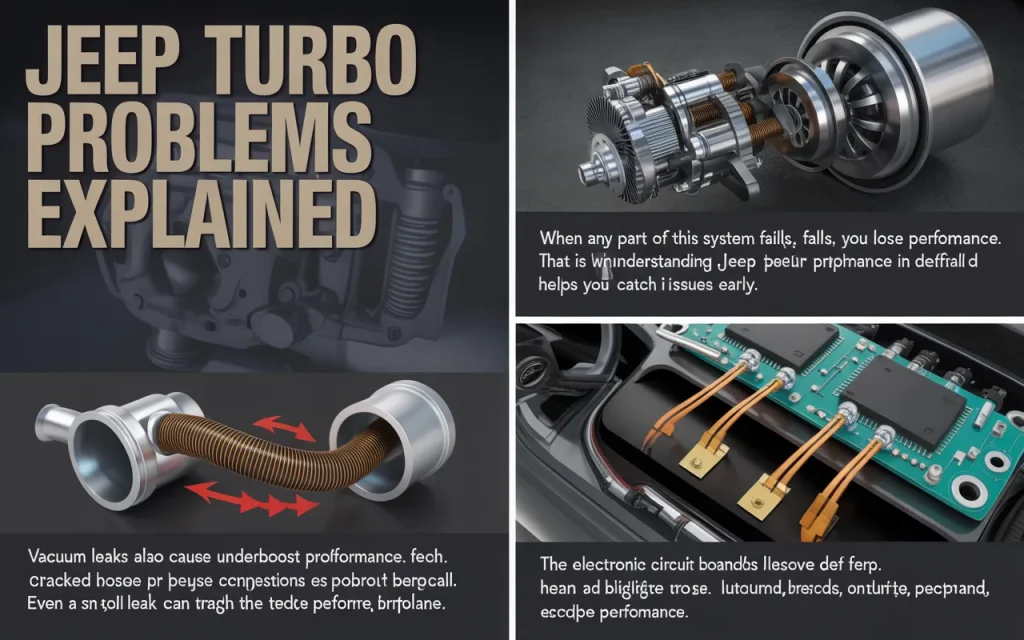
Monitor your gauges. If you have a boost gauge, watch pressure during acceleration. Lower than normal boost confirms underboost conditions. No boost at all suggests major problems .
| Symptom | What To Check | Possible Fix |
|---|---|---|
| Low power, code P0299 | Actuator movement, boost leaks | Replace actuator, repair hoses |
| Whining noise | Turbo bearings, oil supply | Oil change, turbo rebuild |
| Blue smoke | Turbo seals, PCV system | Turbo replacement, valve fix |
| Overheating | Coolant level, thermostat | Refill coolant, replace thermostat |
Preventing Turbo Problems Before They Start
The best repair is the one you never need. Regular maintenance prevents most Jeep turbo problems explained in this article.
Oil changes matter more for turbo engines than anything else. Turbos spin at hundreds of thousands of RPM. They float on a thin film of oil. Old or low oil destroys bearings quickly. Change oil every 5,000 to 7,500 miles using the exact oil grade Jeep recommends .
Let the turbo cool down. After highway driving or off-road use, let your Jeep idle for a minute before shutting off. This lets oil circulate and carry heat away from the turbo bearings. Sudden shutdowns after hard driving cook the oil inside the turbo .
“The most common turbo failure we see comes from people shutting off hot engines immediately. That heat soak breaks down the oil and kills bearings. Thirty seconds of idle time prevents thousands in repairs.” – James Wilson, Master Technician at Mountain Peak Jeep Service
Check coolant weekly. A quick look at the reservoir takes seconds but catches leaks early. Low coolant leads to overheating, and overheating kills turbochargers .
Use quality fuel. The 2.0L turbo engine prefers premium fuel. Lower octane can cause knocking, which stresses the engine and turbo system .
Repair Options: Fix, Rebuild, or Replace
When your turbo fails, you have choices. The right option depends on your budget and how long you plan to keep the Jeep.
Actuator replacement fixes many boost problems without touching the turbo itself. If the turbo spins freely and makes no noise, the actuator might be the only bad part. Replacement actuators cost less than a full turbo .
Turbo rebuilding works when bearings fail but the housing and wheels are good. Rebuild kits include new bearings, seals, and gaskets. A shop can rebuild your turbo for less than a new one costs.
New turbochargers cost the most but provide peace of mind. You get all new parts and a warranty. For newer Jeeps, this is often the best choice .
Used turbos save money but carry risk. You do not know the history or condition. A used turbo might fail soon after installation.
Real Owner Experiences With Jeep Turbo Longevity
How long do Jeep turbos last? The answer varies widely based on maintenance and driving habits.
Some owners report 150,000 miles or more on original turbos. These are typically people who follow maintenance schedules, use quality oil, and let turbos cool down .
Others experience failures before 50,000 miles. These often involve neglected maintenance or unusual issues like manufacturing defects. Early 2.0L engines had more problems than later versions .
Forum discussions show mixed opinions about the Hurricane engine. Some call it the best Jeep engine in years. Others label it unreliable. The truth lies somewhere in between – it performs well when maintained but suffers when neglected .
“I have 95,000 miles on my 2019 Wrangler 2.0L with no turbo problems. I change oil every 5,000 miles with synthetic and always use premium fuel. The engine runs like new.” – David Chen, Wrangler Owner
Frequently Asked Questions
Q: How much does it cost to replace a Jeep turbo?
A: Replacement costs range from $1,500 to $3,500 depending on the model and whether you use new or rebuilt parts. Labor adds several hours to the bill .
Q: Can I drive with a bad turbo?
A: You can drive short distances with reduced power, but continued driving risks damage. Failed turbo seals can send oil into the engine or exhaust, causing more problems .
Q: Does the Jeep 2.0L turbo have timing belt or chain?
A: The 2.0L Hurricane uses a timing chain, which typically lasts the engine’s lifetime. No scheduled replacement is needed .
Q: Why does my Jeep blow white smoke on startup?
A: White smoke on cold startup is often normal condensation burning off. If it continues after warmup or smells sweet, you might have a coolant leak .
Q: How often should I change oil in a turbo Jeep?
A: Every 5,000 to 7,500 miles with full synthetic oil. Shorter intervals protect the turbo better, especially if you tow or off-road frequently .
Q: What does the P0299 code mean for my Jeep?
A: P0299 means the engine computer detects lower turbo boost pressure than expected. Common causes include faulty actuators, boost leaks, or carbon buildup .
Q: Are newer Jeep turbos more reliable than older ones?
A: Generally yes. The 2020 and newer 2.0L engines have fewer reported issues than 2018-2019 models. Manufacturers continuously improve designs .
Conclusion
Jeep turbo problems explained in this article show a pattern – most issues come from maintenance neglect or specific part failures rather than fundamental design flaws. The turbo actuator causes many boost problems. The 2.0L engine needs careful oil and coolant attention. But thousands of Jeep owners enjoy trouble-free turbo miles with proper care.
If you own a turbo Jeep, stay ahead of problems. Watch for symptoms, maintain schedules, and address warning signs quickly. A little attention prevents major repairs and keeps your Jeep running strong.
Whether you drive a Wrangler, Cherokee, or Grand Cherokee, understanding your turbo system helps you make smart decisions. Listen to your Jeep, learn its normal sounds and behaviors, and you will catch problems before they leave you stranded.
This article draws on real owner experiences, technical service manuals, and professional mechanic insights to provide accurate, helpful information about Jeep turbo systems.
Related posts
 Best Car Mats for All-Weather Use 2026: Top Picks for Every Driver
Keeping your car clean is tough, especially when rain, mud, and snow are involved. That’s where the best car mats for all-weather use make a difference.…
 Best Custom-Fit Floor Mats for Nissan Titan: Top Picks 2026
These custom-fit mats provide reliable coverage and help protect your Nissan Titan’s interior from dirt and spills. It’s Monday morning, you’re rushing out the door with…
 Best Car Cleaning Wipes for Interior: A Buyer’s Guide
Discover the best car cleaning wipes for your interior. Compare options for dashboards, leather, and tough stains to keep your car spotless and well-maintained. Keeping your…