
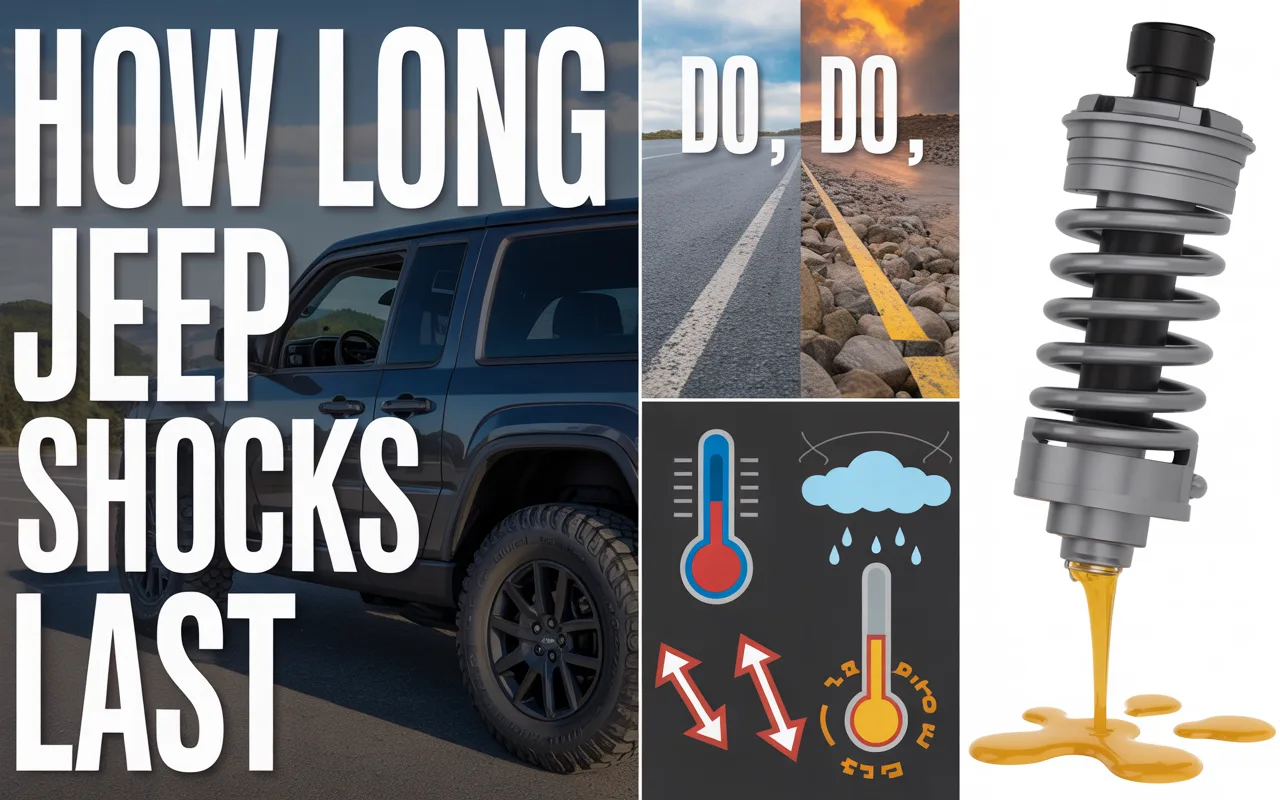
If you are wondering how long do Jeep shocks last, the simple answer is 30,000 to 60,000 miles. But your driving style and terrain matter a lot. Let’s explore the details together.
So you own a Jeep. You love the open road, or maybe you love the muddy trails. Either way, you want your ride to feel smooth and safe. That is where your shocks come in. Shocks do a big job. They keep your tires on the ground. They stop your Jeep from bouncing all over the place. But like all parts, they wear out over time.
I have talked to many Jeep owners over the years. The number one question I hear is, how long do Jeep shocks last? It is a fair question. Nobody wants to spend money on new parts before they need to. But you also do not want to drive around on worn-out shocks. That can be dangerous.
In this article, we will talk about the lifespan of Jeep shocks. We will look at signs of wear. We will discuss different driving conditions. We will even look at two helpful tables. By the end, you will know exactly what to expect from your Jeep’s shocks.
What Do Shocks Actually Do?
Before we talk about how long they last, let us talk about what they do. Shocks, or shock absorbers, control the movement of your springs. When you hit a bump, your springs compress. They want to release that energy. Shocks slow that movement down. They stop your Jeep from bouncing.
Good shocks mean a comfortable ride. They also mean better control. When you turn, you want your Jeep to stay flat. When you brake, you want it to stop without diving forward. Shocks help with all of that.
If you are asking how long do Jeep shocks last, you are really asking how long they can do this job well. And that depends on a few things.
The General Lifespan of Jeep Shocks
Most mechanics will tell you that shocks last between 30,000 and 60,000 miles. That is a wide range. Why the gap? Because not all Jeeps are driven the same way.
If you drive mostly on paved roads, your shocks will likely last closer to 60,000 miles. If you love off-roading, you might need new shocks around 30,000 miles. Some high-performance shocks can last even longer. But 50,000 miles is a good average to keep in mind.
Let me share a quote from a trusted source in the Jeep community.
“I have seen stock Jeep shocks go 70,000 miles on pavement lovers. But for my friends who hit the rocks every weekend, 30,000 miles is the magic number.” – Mark Thompson, off-road enthusiast and mechanic for 15 years
So when you think about how long do Jeep shocks last, think about your own driving first.
Factors That Affect Shock Lifespan
Driving Terrain
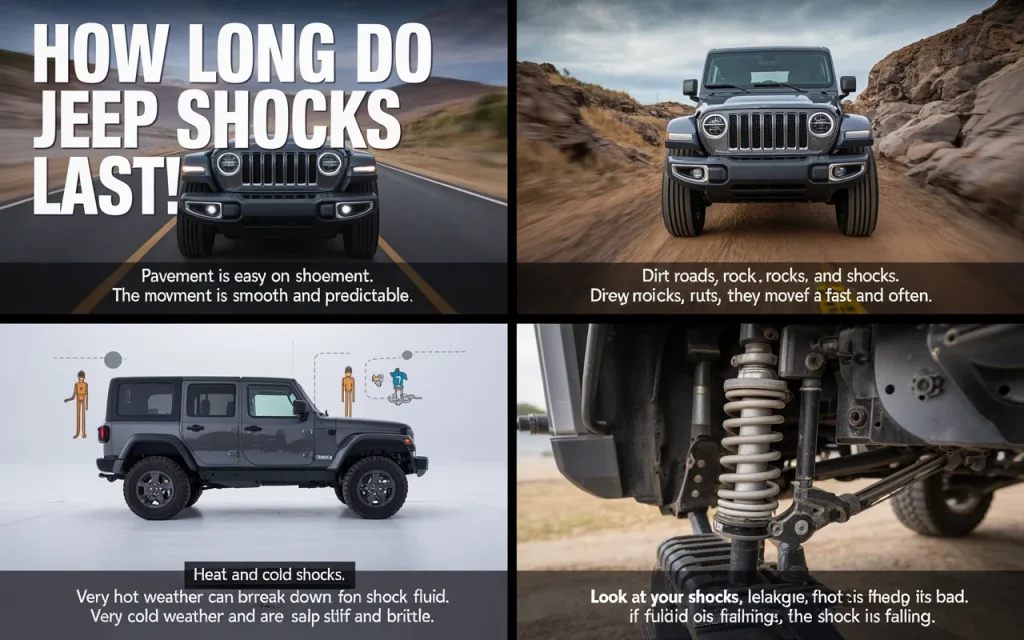
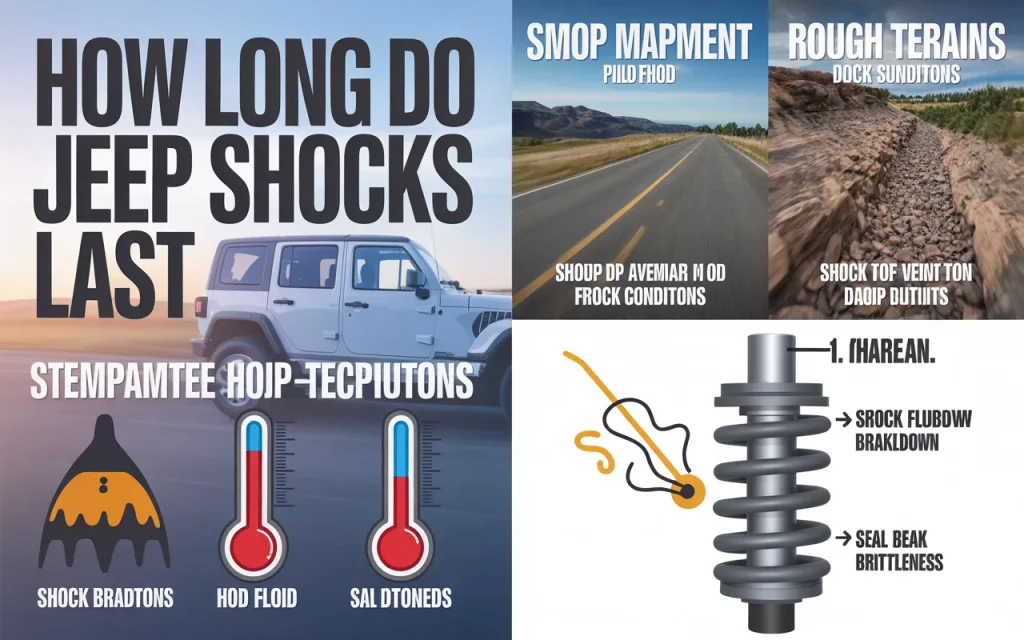
This is the biggest factor. Pavement is easy on shocks. The movement is smooth and predictable. Dirt roads, rocks, and deep ruts are hard on shocks. They move fast and often. They heat up more. Heat breaks down the fluid inside shocks. When the fluid breaks down, the shock stops working.
Load Weight
Do you carry heavy gear? Do you tow a trailer? Extra weight puts more stress on your shocks. They have to work harder to control all that mass. If you frequently drive with a heavy load, expect to replace shocks sooner.
Quality of Shocks
Not all shocks are made the same. Factory shocks are okay. They are built to a price point. Aftermarket shocks can be much better. Brands like Bilstein, Fox, and Rancho build shocks for tough conditions. They cost more, but they last longer and perform better.
Climate
Heat and cold affect shocks. Very hot weather can break down shock fluid. Very cold weather can make seals stiff and brittle. If you live in an area with extreme temperatures, your shocks may wear out faster.
Here is a simple table to help you understand the expected lifespan based on driving habits.
| Driving Type | Expected Shock Lifespan |
|---|---|
| Mostly highway and city streets | 50,000 – 70,000 miles |
| Mixed driving (some gravel, some pavement) | 40,000 – 55,000 miles |
| Frequent off-roading or heavy towing | 25,000 – 40,000 miles |
This table gives you a rough idea of how long do Jeep shocks last for your specific situation.
Signs Your Shocks Are Wearing Out
Your Jeep will tell you when something is wrong. You just have to listen. Here are the most common signs that your shocks are getting tired.
Bumpy Ride
If you feel every little crack in the road, your shocks might be done. A good shock absorbs small bumps. A worn shock lets them pass right through to your seat.
Nose Diving
When you hit the brakes, does the front of your Jeep dip down a lot? That is called nose diving. Shocks control that movement. If they are weak, the front drops too much.
Body Roll
Take a turn a little faster than normal. Does your Jeep lean to one side? That is body roll. Good shocks keep your Jeep flat in corners. Worn shocks let it sway.
Leaking Fluid
Look at your shocks. If you see oil leaking down the side, that is bad. Shocks are sealed units. If fluid is coming out, the shock is failing.
Bouncing
Try the bounce test. Push down hard on the front corner of your Jeep. Let go. If it bounces more than two times, your shocks are weak. A good shock will stop the bounce right away.
I remember talking to a fellow Jeeper about this.
“I did not realize my shocks were bad until I drove my friend’s Jeep. His ride was so smooth. Mine felt like a wagon. That is when I checked and saw the leaks.” – Sarah Jenkins, Jeep Wrangler owner
If you notice any of these signs, it is time to think about replacement. Knowing how long do Jeep shocks last helps you plan, but your driving experience is the real test.
Different Shocks for Different Jeeps
Jeep makes many models. Wrangler, Grand Cherokee, Gladiator, Renegade. Each one has different shocks. They are tuned for that specific vehicle.
Wrangler Shocks
Wranglers are built for off-road. The shocks have more travel. They are softer to handle rocks and ruts. But that softness can wear them out faster on pavement.
Grand Cherokee Shocks
Grand Cherokees focus on comfort. The shocks are tuned for a smooth highway ride. They often last longer because the vehicle is heavier and more stable.
Gladiator Shocks
The Gladiator is a truck. It needs shocks that can handle payload. They are stiffer than Wrangler shocks. They last well if you do not overload the bed.
No matter which model you drive, the question remains: how long do Jeep shocks last? The answer is still tied to how you drive and maintain them.
When to Check Your Shocks
You should not wait for problems to check your shocks. Make it part of your regular routine. Every time you change your oil, take a look. Look for leaks. Look for damage. Push down on the corners.
If you drive off-road often, check more frequently. Mud and dirt can damage shock seals. Rocks can dent the shock body. A small dent might not seem like a big deal, but it can stop the shock from moving freely.
Here is another table to help you with a simple inspection checklist.
| What to Check | What to Look For |
|---|---|
| Visual inspection | Leaking fluid, dents, rust |
| Bounce test | More than two bounces after pushing down |
| Noise test | Clunking or rattling over bumps |
| Ride feel | Excessive vibration or harshness |
| Tire wear | Cupping or uneven wear patterns |
Checking these items regularly will help you understand how long do Jeep shocks last on your personal vehicle.
Can You Extend the Life of Your Shocks?
Yes, you can. Shocks are wear items. They will eventually need replacement. But you can help them last longer.
Drive Smoothly
Hard braking and fast turns stress shocks. Smooth driving is easier on them. Give yourself extra time to stop. Take turns at reasonable speeds.
Reduce Extra Weight
Do not carry heavy stuff if you do not need to. Every extra pound makes your shocks work harder. Clean out the back. Remove roof racks when not in use.
Wash Your Jeep
If you off-road, wash the undercarriage. Mud and salt are bad for shocks. They can damage the seals. A quick rinse after a trail ride can add months to shock life.
Use Shock Covers
Some off-roaders use shock covers. These fabric sleeves keep dirt off the shock shaft. If the shaft gets dirty, it can scratch the seal. A scratched seal means a leaking shock.
I asked a suspension expert for his thoughts.
“People forget that shocks are hydraulic. They have fluid and seals. Keep them clean and cool, and they will last much longer. I tell my customers to spray them down after every muddy trip.” – Dave Chen, suspension specialist
So if you are worried about how long do Jeep shocks last, a little care goes a long way.
Choosing New Shocks
When the time comes, you will need to pick new shocks. This can feel overwhelming. There are so many choices. But it is simpler than it looks.
Stock vs. Upgrade
You can buy stock replacement shocks. They are fine. They will feel exactly like your old ones did when new. But if you want better performance, look at upgrades.
Gas vs. Hydraulic
Most modern shocks are gas-charged. They have nitrogen gas inside. This reduces foaming of the fluid. Foaming makes shocks less effective. Hydraulic shocks are cheaper but not as consistent.
Remote Reservoir
If you off-road hard, consider remote reservoir shocks. They have a separate canister for fluid. This keeps the shock cooler. Cooler shocks last longer and work better.
Lift Kits
If you lifted your Jeep, you need longer shocks. Standard shocks will not work. They will bottom out and break. Make sure you buy shocks matched to your lift height.
Knowing how long do Jeep shocks last helps you decide what to buy next. If you drive hard, spend more on quality. If you drive easy, stock parts are fine.
Cost of Replacement
Let us talk money. Shock prices vary a lot.
- Basic shocks: $40 to $80 each
- Mid-range shocks: $80 to $150 each
- High-end shocks: $150 to $400 each
Labor costs depend on where you live. A shop might charge $100 to $200 for installation. Some Jeeps are easy to work on. Others take more time.
You can save money by doing it yourself. Shocks are not hard to replace. You need basic tools and a jack. Watch a few videos. Take your time. If you can change a tire, you can probably change shocks.
But remember, even if you spend more on quality shocks, they last longer. That means you replace them less often. So the cost over time might be the same.
Safety First
I want to be clear about something. Worn shocks are not just uncomfortable. They are unsafe. Your stopping distance gets longer. Your handling gets worse. Your tires wear unevenly. In rain or snow, bad shocks can cause you to lose control.
Do not wait until your ride is terrible. Check your shocks now. If you are near 50,000 miles and you drive hard, just replace them. It is worth the peace of mind.
Here is one more thought from a Jeep club member.
“I slid off a wet road once because my rear shocks were shot. I did not know they were bad. Now I check everything twice a year. Safety is not worth skipping.” – Mike Reynolds, Jeep club president
So when you ask how long do Jeep shocks last, remember that safety is the real reason to pay attention.
Frequently Asked Questions
Can I drive with bad shocks?
You can, but you should not. Bad shocks reduce control and increase stopping distance. They also wear out your tires faster.
Do all four shocks wear out at the same time?
Not always. Front shocks often wear faster because they handle more weight from the engine. But it is best to replace them in pairs or all four at once.
How do I know if I need shocks or struts?
Jeeps use shocks, not struts. Struts are structural parts that hold the vehicle up. Shocks just control movement. Your Jeep has shocks on all four corners.
Will new shocks improve my ride?
Yes. New shocks will make your Jeep feel tighter and more controlled. Bumps will feel smaller. Cornering will feel flatter.
Does lifting my Jeep affect shock life?
Yes. Lifted Jeeps change the angle of the shocks. This can make them wear faster. Use shocks made for lifted vehicles to avoid problems.
How long do Jeep shocks last on a Wrangler?
On a Wrangler, expect 30,000 to 50,000 miles with normal driving. Off-road use will lower that number.
Conclusion
So let us wrap this up. How long do Jeep shocks last? Most last between 30,000 and 60,000 miles. Your driving habits decide where you fall in that range. If you stay on pavement and drive smooth, you will get more miles. If you love trails and rocks, you will need new shocks sooner.
Pay attention to the signs. Bumpy rides, leaking fluid, and body roll all mean trouble. Check your shocks regularly. A quick look during oil changes is enough.
When you need new ones, pick shocks that match your driving style. Stock is fine for daily drivers. Upgrade if you push your Jeep hard. And remember, clean shocks last longer. Wash off the mud. Keep them cool. Drive smooth when you can.
Your Jeep works hard for you. It takes you places. It brings you home. Take care of it, and it will take care of you. Shocks are a small part, but they make a big difference. Do not ignore them.
If you are near 50,000 miles and you cannot remember the last time you changed your shocks, go take a look. Push down on the corners. Check for leaks. Your butt will thank you on the next bumpy road.
Thanks for reading. I hope this helped you understand how long do Jeep shocks last. Now get out there and enjoy the drive.